
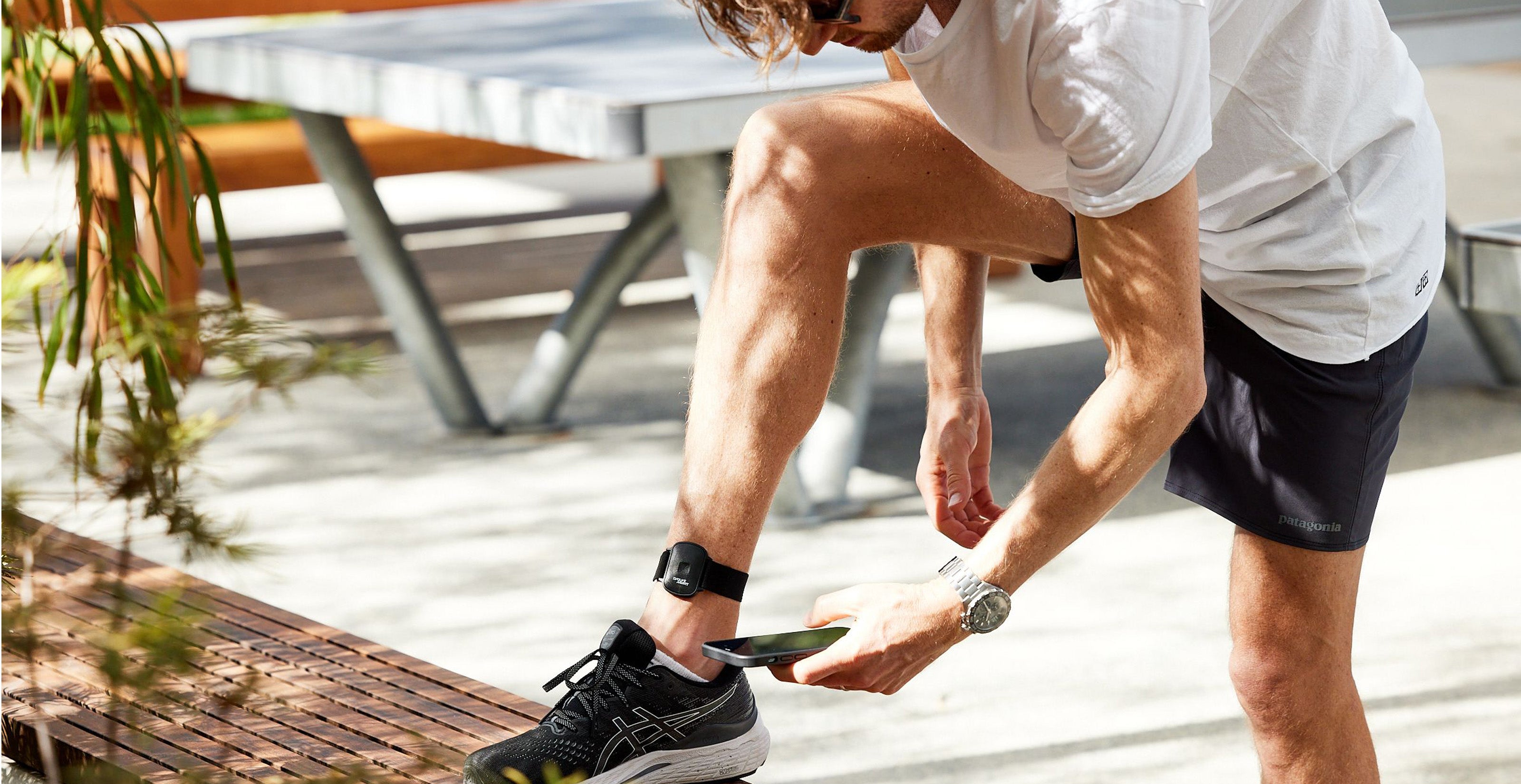
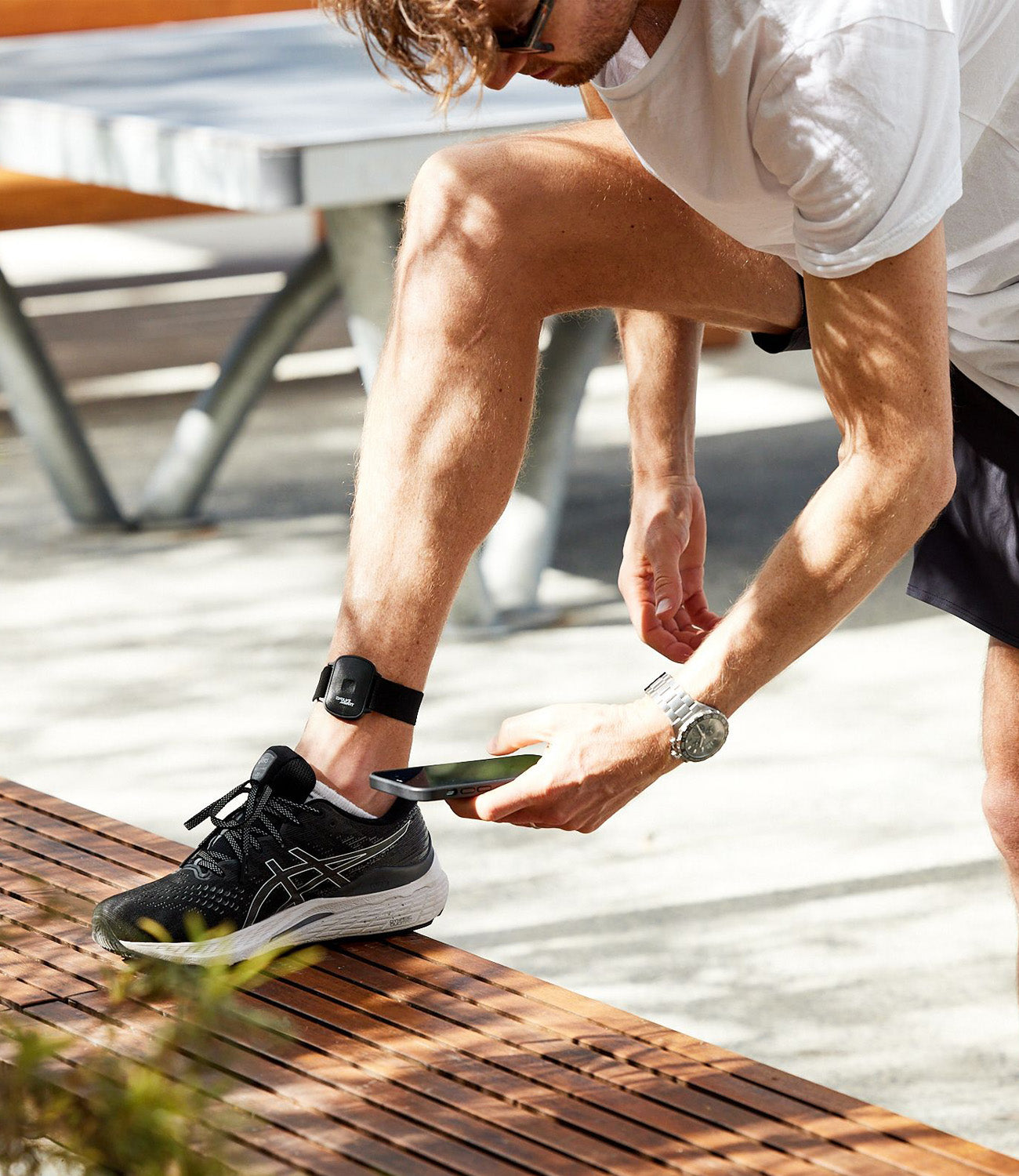
A GUIDE TO
Let's get started
What to expect when your device arrives
Welcome to your EVOLVE MVMT journey! Your device will be half charged when it arrives, we recommend you charge it to full charge before your first use. The charging unit connects to any standard USB port charger.
Download the app
Setup your profile
Make sure you're connected to good wifi before you begin using the app. The app will guide you through the process to enter your details to set up your profile, connect your EVOLVE MVMT device(s) and start your exercise session.
Step-by-step guide for your first session
Step 1: Open the app and ‘Start’ session
Step 2: Complete your exercise settings
Step 3: Select Exercise Type ‘walk or run’
Step 4: Select Shoe Type (for your first session you will need to add your shoe type)
Step 5: Select Surface
Step 6: Ignore ‘Run/Walk Thresholds’ as this will be calculated by the app after your first session
Step 7: Hit ‘Continue’
Step 8: Follow these steps to connect device(s)
Step 9: Turn one device on at a time (the green light will be flashing on device)
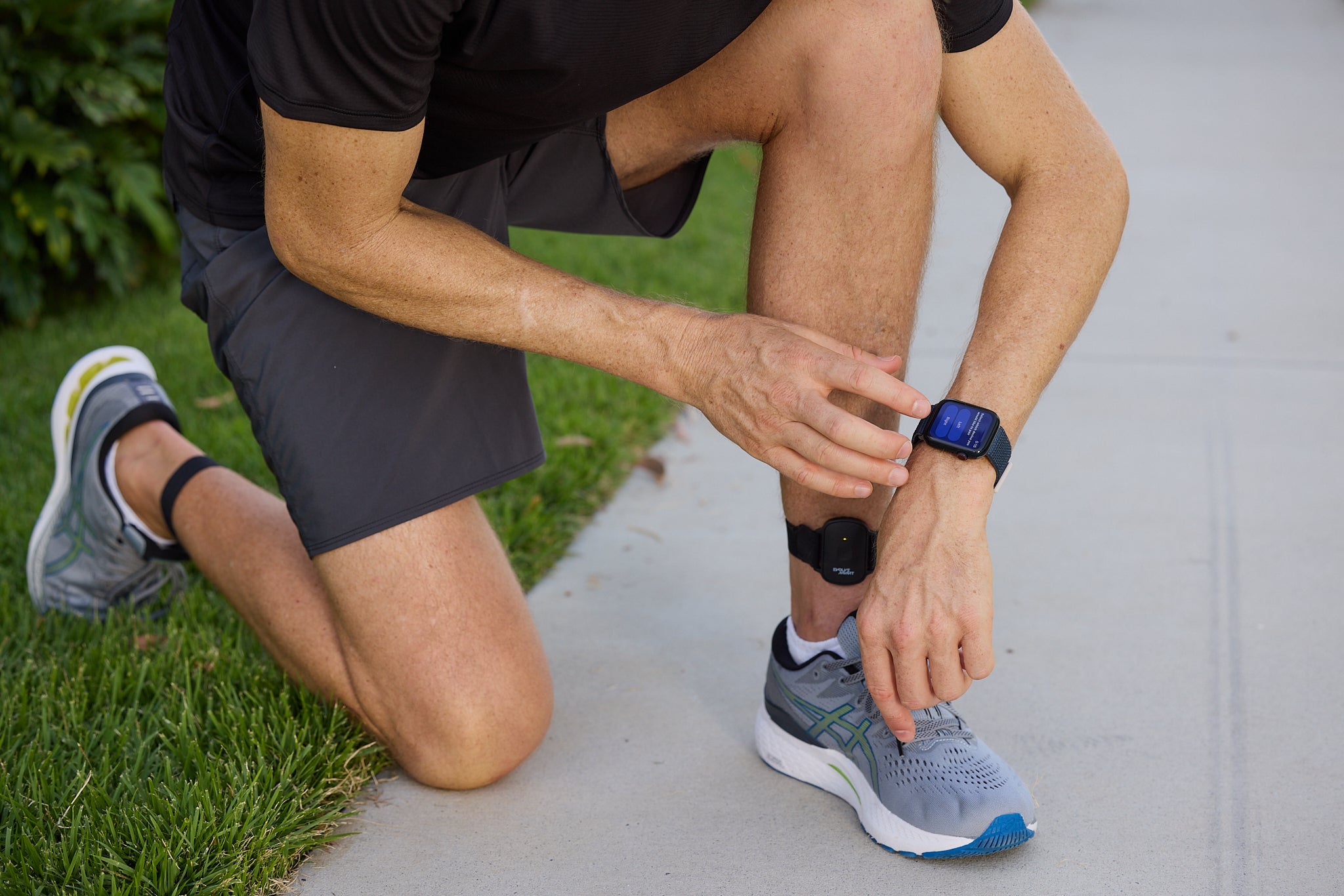
Step 10: Hit Left or Right side as appropriate and shake the device in your hand or tap your ankle if it is already on your leg.
Step 11: Once connected the box will light up and say ‘Connected’ as well as the battery life of your device
Step 12: Repeat for opposite side
Step 13: Press ‘Continue’ at the bottom of the screen
Step 14: Session Mode: choose Live (to stay connected with your phone to see live data) or Free (disconnected to do a session without using your phone - this is how you can use your Apple Watch or run/walk without a device).
Note: For Free App Disconnected sessions, please refer to Support section at the bottom of this page to see how to do this.
Step 15: Hit ‘Start Session’ to commence your walk/run
Note: If you are running/walking with your phone, you will need to keep the app open (do not close the app or allow the phone screen to lock during the session) to avoid it cutting out.
Note: During your session in the top right corner you can toggle between walk or run if you are changing throughout your session.
Step 16: At the end of your walk/run hit ‘Stop Session’
Step 17: Your session will now be in your session history to analyze your data
EVOLVE MVMT Quick Overview

- Device
- Charging Cable
- Charging Base
- Strap
- Get-Start Guide
- Device
- Charging Cable
- Charging Base
- Strap
- Get-Start Guide
Using EVOLVE MVMT for Running
From the home screen there is a button to start a run. When you’re ready to start your run, click the button to record your running data. For the first run you do, you will need to select your exercise type as 'run' as well as shoe type and surface. You can adjust these settings when necessary.
What feedback does the app give?
The EVOLVE MVMT sensor will prompt you throughout your run with a vibration when you are taking steps under your thresholds (performing poor steps). You can also view your step performance live on the app screen. Each step is indicated with a circle which represents the performance of your step visually. A small circle indicates a good quality step, whereas a large circle indicates a bad step. A good step is also displayed higher on the screen, a bad step is displayed lower on the screen. Your threshold for each step is marked by the dotted line on the screen and is generated by the software to be personalized to your running technique to help improve your performance as optimally as possible.
Can I use my phone while using the app?
As the app is designed for you to be viewing your data live, you can’t take calls or lock the screen during use. Once you feel confident that you don’t need to review your performance on the screen anymore, you can use the sensors independently of the app and the sensor will work on the same parameters you've set. This includes the surface, shoes and corresponding thresholds of your last run. So you’ll still feel the live feedback of vibrations to keep you walking optimally. See support section at the bottom of this page for how to setup your session to run without your phone (Free - App Disconnected).
Metrics Explained
Thresholds
A threshold is the level of walking or running you are trying to achieve in the short term (i.e., each session). This is your performance level you should be working above to improve your technique. These thresholds are determined by your individual characteristics and movement patterns. The thresholds are marked as dotted lines on the screen. When you step, you will see if your step is above (good) or below (needs refinement) the threshold line.
Baseline
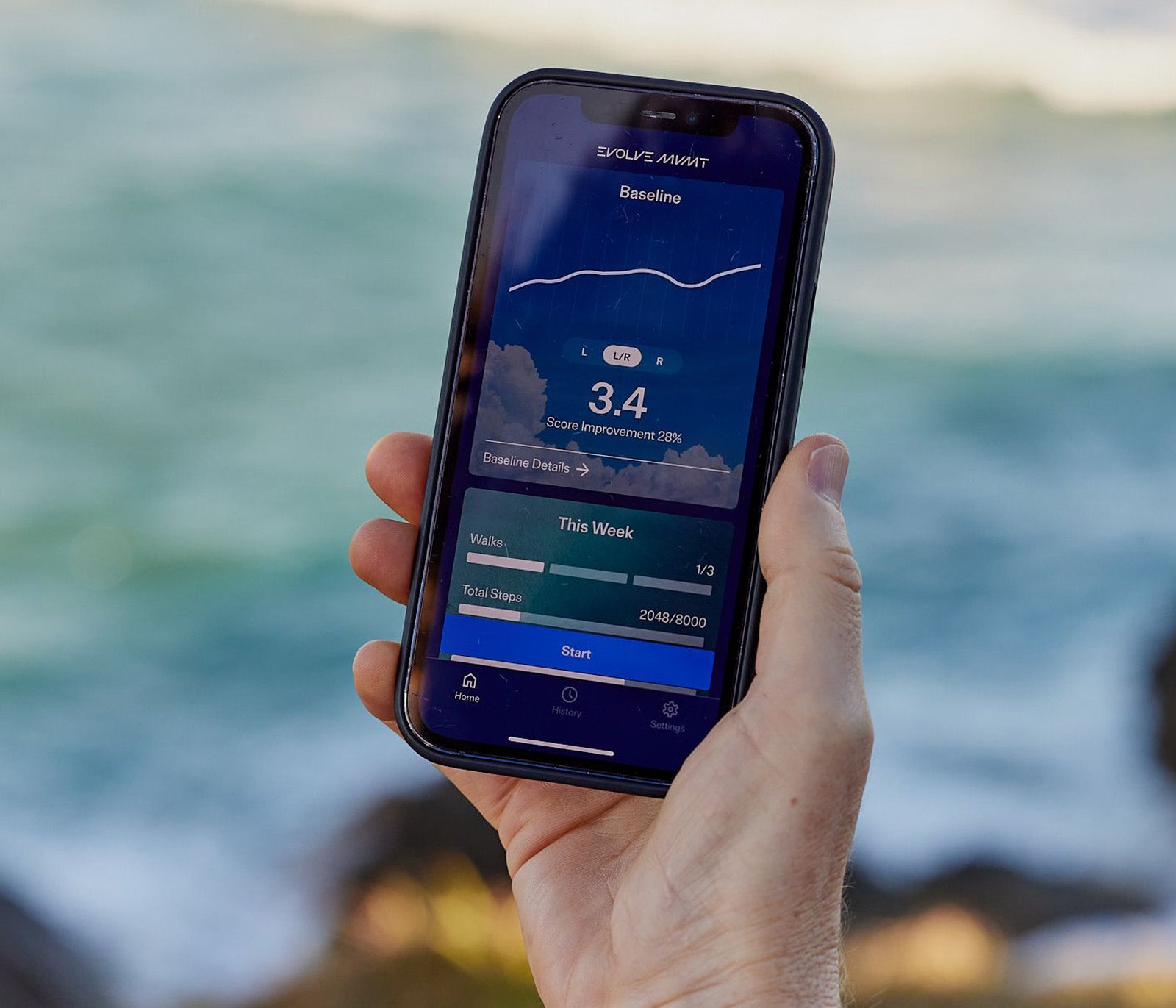
Your original baseline is the level of walking or running you naturally performed before using EVOLVE MVMT. You can perform a baseline score. This will then be used to reference your improvement and generate thresholds for you to perform above when you are walking or running.
Scores
With EVOLVE MVMT your walking or running performance is analyzed in real time and a score is generated, out of ten (to one decimal point). The higher the score, the better your technique. As you would imagine, there are varying degrees of efficiency to which people move. We are seeing a normal variation in people’s baseline walking from 4-7’s and an improvement of 0.5-2.5 points specifically with light walking.
A threshold is the level of walking or running you are trying to achieve in the short term (i.e., each session). This is your performance level you should be working above to improve your technique. These thresholds are determined by your individual characteristics and movement patterns. The thresholds are marked as dotted lines on the screen. When you step, you will see if your step is above (good) or below (needs refinement) the threshold line.
Your original baseline is the level of walking or running you naturally performed before using EVOLVE MVMT. You can perform a baseline score. This will then be used to reference your improvement and generate thresholds for you to perform above when you are walking or running.
With EVOLVE MVMT your walking or running performance is analyzed in real time and a score is generated, out of ten (to one decimal point). The higher the score, the better your technique. As you would imagine, there are varying degrees of efficiency to which people move. We are seeing a normal variation in people’s baseline walking from 4-7’s and an improvement of 0.5-2.5 points specifically with light walking.
Using EVOLVE MVMT for Walking
From the home screen there is a button to start a walk. When you’re ready to start your walk, click the button to record your walking data. For the first walk you do, you will need to select your shoe type and surface. You can adjust these settings when necessary.
How to perform a baseline
Next you will perform a baseline walk using your natural walking style. This should be performed on a 30-foot hard surface walkway (i.e., concrete or asphalt) in bare feet. This will allow for accurate long-term performance analytics. A score will be generated out of 10 for how optimised your walking technique is. A 10 is a perfect score, most users perform between 4-7 naturally. For those using one sensor, you will be guided through performing a baseline test on both legs, swapping your sensor to the opposite side and generating scores for each leg.
How to perform a 'light walk' baseline
Next you will be guided through EVOLVE MVMT’s light walking technique. You will perform your first EVOLVE MVMT light walking baseline. This will generate your first light walking score, you will see an improvement from your first natural walking baseline. Over time you will see this improve vastly as you perfect your light walking technique. Once the light walking baseline is complete, you will have completed your on-boarding process. You will now have access to the home screen, where you can immediately review your improvement in your baseline where your score is displayed.
What feedback does the app give?
The EVOLVE MVMT sensor will prompt you throughout your walk with a vibration when you are taking steps under your thresholds (performing poor steps). You can also view your step performance live on the app screen. Each step is indicated with a circle which represents the performance of your step visually. A small circle indicates a good quality step, whereas a large circle indicates a bad step. A good step is also displayed higher on the screen, a bad step is displayed lower on the screen. Your threshold for each step is marked by the dotted line on the screen and is generated by the software to be personalised to your walking technique to help improve your performance as optimally as possible.
What do I see after a completed walk?
Once you’ve completed your walk, you’ll see a summary of your walk (steps, time spent walking, thresholds). You can also label a walk to allow you to compare it to other walks in the future.
Can I use my phone while using the app?
As the app is designed for you to be learning how to light walk, you can’t take calls or lock the screen during use. Once you feel confident that you don’t need to review your performance on the screen anymore, you can use the sensors independently of the app and the sensor will work on the same parameters you've set. This includes the surface, shoes and corresponding thresholds of your last walk. So you’ll still feel the live feedback of vibrations to keep you walking optimally.
Support & FAQs
Do I need to charge the device?
Yes, please fully charge the device before first use.
How to charge EVOLVE MVMT:
- Plug the charger in, the light will begin flashing blue, indicating the device is charging.
- When fully charged, the light will turn solid blue (no flashing).
- To stop charging, remove the device from the charging unit or unplug the cable.
- Once removed, the device will flash green, indicating it’s ready to use.
To turn the device off:
Press and hold the button (the central depression on the device) for 2 seconds.
The light will turn off, confirming the device is powered down.
How to pair the device
To pair your EVOLVE MVMT device with the mobile app:
- Open the EVOLVE MVMT app and go to the Connect Devices screen
- Select which leg you are pairing the device to
- Turn the device on
- Gently shake the device to initiate pairing
- Once paired, the app will display the device information
- Repeat for the other leg if using two devices
Make sure:
- Bluetooth is enabled on your phone
- Bluetooth permissions are allowed for the app
- The app remains open during pairing
Once paired, you’re ready to begin your session.
How to turn the device on and off
To turn the device on
- Press and hold the button (central depression on the device) for 2 seconds
- The green light will begin flashing, indicating the device is on
To turn the device off
- Press and hold the button for 3 seconds
- The device will flash green three times, then the light will turn off
The device will also automatically power down after 5 minutes of inactivity if it is not paired to the app, to conserve battery.
What do the lights on the device mean?
The LED light on the EVOLVE MVMT device communicates its status during use and charging.
Green flashing
- Device is powered on
- Slow flash = walking
- Fast flash = running
Amber flashing
- Device is powered on in Free mode (recording without the app open)
- Slow flash = walking
- Fast flash = running
Solid green
- Live (app-connected) session is paused
Solid amber
- Free mode session is paused
Red flash
- A step has been detected below your performance threshold
Two red flashes
- Low battery, please recharge before your next session
Blue flashing
- Device is charging
Solid blue
- Device is fully charged
Three quick green flashes
- Device is powering down
No light
- Device is turned off
How do I know how much charge is in the device?
Just before starting a walk or run, you’ll pair the device with your smartphone.
Once paired, the app will display the device ID along with the current battery level, so you can easily check how much charge remains before your session.
How to run/walk without your phone (disconnected session)
What is a disconnected session?
If you want to walk/run without holding your phone, you can set your devices up to work independently from your phone. Follow these steps to do this:
Step 1: Open the app and ‘Start’ session, complete your exercise settings.
Step 2: Connect device(s)
Step 3: ‘Session Mode’ choose ‘Free (App Disconnected)’
Step 4: Hit ‘Start Session’
Note: From now, you can put your phone down as your device(s) is working independently from your phone.
Step 5: You will notice your device(s) is no longer flashing and the light is solid
Step 6: As soon as you are ready to start your run/walk, press each device button once. The light will change to flashing to signify that it has commenced recording your session. (Note: do not activate your device(s) until the moment you want to begin recording, as all data will be collected from this point)
Step 7: Complete your run/walk. Note: the devices will still give you vibration feedback to indicate poor steps.
Step 8: As soon as you complete your run/walk, hold the button down for 2 seconds to turn the devices off.
Step 9: Open the app and go to the Home Screen.
Step 10: There will be a notification at the top of the screen asking you to ‘offload’ your last session.
Step 11: Press the notification to start the offloading process.
Step 12: Connect device(s). Do not worry about which device is left or right if you have mixed them up, the app will figure out the correct device for each side.
Step 13: Once your session is offloaded, the bottom of the screen will take you to review your session history.
Step 14: Analyze your session.
Which leg should I wear EVOLVE MVMT on (for single device use)?
If you’re using EVOLVE MVMT independently, we recommend switching legs every other week.
To build meaningful insights, try to run the same routes or loops multiple times on each leg, so the data is comparable.
How tight should the ankle strap be?
The strap should feel snug but comfortable:
- Tighter than calf compression socks
- Secure, without feeling restrictive
The strap will stretch slightly over time to suit your ankle. If you’re between sizes, a larger strap may be more comfortable.
What does the step score (1–10) mean?
The step
score is a biofeedback scale developed by our clinical team:
- 10 = optimal shock absorption and efficiency
- 5 = average performance (typical for healthy runners and walkers)
- 1 or below = poor shock absorption
Scores below 1 indicate inefficient shock absorption that is often visible to a trained clinician.
Why do my sprint sessions score lower than slower runs?
This is a common and valuable insight. Lower scores during sprinting often indicate:
- Reduced shock absorption efficiency
- Increased force transmission through the body
Many runners discover they are more efficient at slower paces, with room to improve high-speed mechanics safely.
What happens when I step below my threshold?
When a step falls below your set threshold:
- The unit vibrates
- The LED flashes red (useful for video analysis)
Thresholds are part of our algorithm and are designed to help you gradually improve technique and performance without increasing injury risk. Thresholds can be adjusted during your 1:1 session.
Can I compare treadmill data to outdoor running?
No, treadmill data should not be compared directly to outdoor running.
Surface mechanics, force absorption, and movement patterns differ significantly. This is something we can explain in more detail during your consultation.
What does EVOLVE MVMT measure that clinicians can’t see?
EVOLVE MVMT measures force transmission beneath the skin, data that cannot be reliably identified through:
- Visual observation
- Video analysis
- Traditional gait assessment
This is why EVOLVE MVMT was originally developed for clinical use.
Why did my session stop recording?
If a session stops unexpectedly, the most common reasons are:
- The app was pushed to the background (e.g. phone calls or switching apps)
- Bluetooth interference from other nearby devices
At this stage, the app must remain the active app to maintain connection. Reconnection functionality is planned for a future update.
What’s the Bluetooth range?
Typical Bluetooth range is approximately 40 feet (12 metres) with no solid objects in between. Normal body movement is already accounted for in our algorithm.
Please see FAQs page for additional questions and resources.